

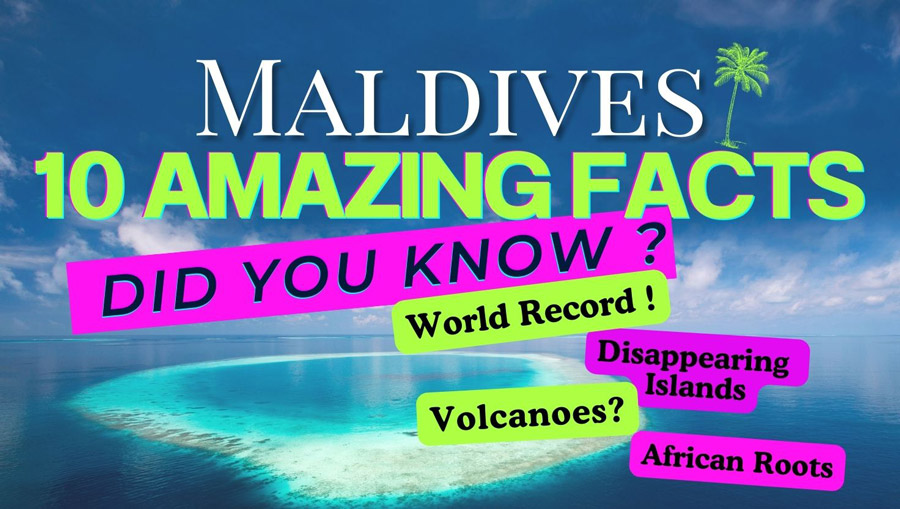
You might think the Maldives is just white sand and blue water, but there is a hidden side to these islands that most travelers completely miss.
I’ve taken my famous list of Maldivian facts and distilled it into the 10 most essential things to know before you go.
The Maldives are dreamy, but these 10 things will change how you see this paradise.

From ancient seafaring traditions to the hypnotic rhythm of Bodu Beru, here is the Maldives like you’ve never seen it before, complete with exclusive YouTube Shorts for every fact.
Short on time ? Watch my full video guide here and explore each fact in depth below.
Nature and Geography of the Maldives
The Smallest Islands on Earth

The Maldives is home to some of the smallest islands on Earth, a geography unlike anywhere else in the world.
On average, an island is just one kilometer long. Some are incredibly tiny, only a few square meters in size. They’re so small you can walk from one side to the other in just a few minutes.
Some are even smaller, nothing more than sandbanks rising from the ocean. Even the largest island in the Maldives is barely six kilometers long.
These islands are unique, delicate, and incredibly fragile. That’s why they need protection.
Explore more in my guide to the smallest resorts in the Maldives, the best boutique hotels.
The Lowest Country on Earth

The Maldives is the lowest country on Earth, a nation living almost at the level of the ocean itself.
There are no mountains and no hills, only flat sand islands surrounded by the ocean. The average elevation is only about 1.5 meters above sea level, and the highest natural point reaches just 2.4 meters.
More than 80% of the country lies below one meter above sea level. This makes the Maldives one of the most vulnerable places on Earth to rising sea levels, a whole nation living almost at the level of the ocean itself.
Born from Ancient Volcanoes

Millions of years ago, something extraordinary happened in the very place we now call the Maldives.
Deep beneath the ocean, immense forces were at work, pressure, heat, and volcanic eruptions. Volcanoes rose from the seabed, shaped by explosions and molten fire. Over time, these giants cooled and slowly sank back into the ocean.
But this was only the beginning. Corals grew around them, forming the ring-shaped atolls we admire today. Over millions of years, these atolls slowly gave rise to the dreamy islands that became the Maldives we know today.
It is extraordinary to think that this paradise was born from ancient volcanoes and took millions of years to become what it is today.
Discover more about how the Maldivian atolls formed in my illustrated guide.
Disappearing Sandbanks

You were in the Maldives last year, on a dreamy sandbank, lost in endless shades of blue… and today, it’s gone.
Did you know this can really happen?
In the Maldives, sandbanks are not fixed islands. They are constantly moving, shaped by tides, currents, and seasonal monsoons. Some exist only at low tide, disappearing completely as the ocean rises, only to reappear hours later.
Others slowly migrate across lagoons as winds shift the sand from one side to another. Sometimes, a single storm is enough to reshape them, or erase them entirely.
These fragile strips of sand are made of coral fragments, broken, carried, and rebuilt by the sea. A place that exists today can literally be gone tomorrow.
The Ocean Creates the Maldives
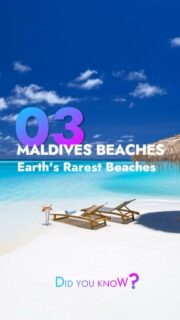
Maldives Sand Is So White, It Creates the Rarest Beaches on Earth

When you walk on a Maldives beach, your feet are touching one of the rarest sands on Earth. There, the sand is among the rarest and whitest you will touch, and its origin is far more extraordinary than most travelers imagine.
Less than 5% of beaches in the world look like this. Unlike most beaches, where sand comes from rock, Maldives sand comes from coral and shells, slowly broken down over hundreds of years.
This is what gives it its dazzling white color and incredibly soft texture.
What feels like pure luxury beneath your feet is in fact a fragile natural wonder shaped by time and the living reef.
The Parrotfish That Builds the Beaches

The parrotfish is one of the quiet architects of the Maldives, helping create the very beaches you walk on.
These colorful fish spend their entire day feeding on coral, crushing it with their powerful beak, which looks just like a parrot’s. If you have ever snorkeled in the Maldives, you may have heard the strange crunching sound underwater, that is the parrotfish feeding.
After digesting what it can, it returns the rest to the ocean as fine white sand. A single parrotfish can produce hundreds of kilos of sand every year, and on some reefs, they are responsible for most of the sand beneath your feet.
They are, quite literally, the quiet architects of paradise.
If you love discovering the extraordinary marine life that shapes the Maldives, explore my guide to the 10 common fishes you will meet while snorkeling in Maldives.
Whale Sharks All Year Round

Whale sharks can be seen in the Maldives all year round, making the islands one of the world’s most extraordinary marine destinations.
In these dreamy waters, from north to south, roams the majestic whale shark, a true giant of the ocean. These incredible creatures can grow up to 18 meters long, the size of a truck.
The Maldives is one of the rare places on Earth where you can encounter them all year round. The country is home to three official whale shark sanctuaries.
The most famous is SAMPA in South Ari Atoll, where sightings are possible throughout the year. Hanifaru Bay and Angafaru Bay offer seasonal encounters from May to November.
To witness these gentle giants in the wild is one of the most extraordinary marine experiences the Maldives can offer.
For more about these majestic giants, take a look at my full post about SAMPA, one of the world’s most unique whale shark sanctuaries.
Maldivian Traditions and Island Culture
Bodu Beru, The Rhythm of the Maldives

Bodu Beru is the traditional rhythm of the Maldives and one of the most powerful expressions of its cultural heritage. You will surely hear these drums during your stay.
In Dhivehi, the local language, “Bodu Beru” means “big drum.” Its roots trace back to East Africa, and its rhythms still carry that heritage today.
It begins with a slow and steady beat, then builds into something powerful and almost hypnotic.
During Maldivian nights, this music often accompanies local food and island celebrations, and it is impossible not to be drawn into its rhythm. It is a sound that truly brings people together, especially under a starry sky.
If you’d like to understand more of the local culture and language behind Bodu Beru, you may also enjoy my post about the Dhivehi language spoken in the Maldives.
Navigation Without GPS

Navigation without GPS is still part of the extraordinary maritime heritage of the Maldives : some Maldivian captains still do not need GPS !
Out at sea, they read the stars, the waves, the color of the water, and the reefs. Light turquoise means shallow waters, while deep blue indicates safe passage.
At night, the stars become their compass. This ancient knowledge has been passed down through generations and reflects the extraordinary maritime heritage of the Maldivian people, true people of the sea.
To discover the beauty of the traditional Maldivian dhoni, you can also explore our tribute photo gallery to the iconic boat of the Maldives.
The dhoni is such an essential part of Maldivian heritage that I also dedicated an entire page to this iconic traditional boat, which you can explore here.
The Meaning of the Maldives Flag

The Maldives flag tells a powerful story of identity, religion, and independence.
It is made of three elements, each carrying a deep meaning. The green stands for the coconut tree, the most common tree across the Maldives. The white crescent represents Islam, the country’s religion.
And finally, the red honors those who fought for independence from British rule in 1965.
But it wasn’t always like this. The Maldives once had a plain red flag. Later, black and white stripes were added on the side, known as the Dhandimathi.
Then, in the early 20th century, the green panel and the crescent appeared. In 1965, the stripes were removed to form the flag you see today.
A simple design, yet a very strong identity.
More Maldives Facts to Explore
The Maldives is far more than a destination. It is a living world shaped by reefs, traditions, marine life, and time itself. And the more you discover it, the more extraordinary it becomes.
Looking for even more fascinating facts ?
Discover our original guide with more insights here 18 Facts You Might Not Know about Maldives


Follow us on Facebook, Youtube and Instagram
for more Maldives Dreams & Stories
Your TOP Best Maldives Resorts 2026
YOUR CHOICE. YOUR DREAM. YOUR VOICE
[ Official ]
Traveler's Choice
15th Edition