

Climate Overview of the Maldives
The Maldivian weather, between blue skies and monsoons.
Maldives weather and general climate are tropical equatorial. The islands benefit from their location near the Equator, which offers stable temperatures throughout the year and protection from cyclones. Their climate is humid and warm with 2 seasons called Monsoons.
With a distance of 800 km from North to South and the Equator crossing the country, the weather conditions will vary according to your location in the archipelago.
As a consequence, standard weather forecast for Male (center North Maldives) will not be valid for the entire archipelago.
If you’re traveling to the far south, below the Equator, it’s best to check the weather forecast for Gan rather than Male.

Maldives Weather & Seasons in Video
When Is the Best Time to Visit the Maldives ?
It is tricky to define the best time to visit the Maldives,
but here are some key insights to guide you.
In a nutshell : the so-called dry season, from late October / November to April, is usually considered the most favorable period. September is often seen as less risky than June, July, or August, when the rainy monsoon is typically at its peak—though it can sometimes remain very active through to October.
That said, beautiful Septembers do happen, with only a few brief showers quickly giving way to sunshine. In recent years, the weather has shown unpredictability, with some rainy seasons starting early—as soon as May—and extending into December, sometimes with unusually strong winds and heavy rains.
Monsoons have clearly slighly shifted, they now arrive later, are more intense, and stretch over longer periods.
Maldives Average Air and Sea Temperatures
General guidance on seasons and weather
Air temperatures in the Maldives remain relatively stable throughout the year.
– Highest temperatures (dry season) : 30°C – 32°C (86˚ – 90˚F)
– Lowest temperatures (rainy season) : 25°C – 28°C (77˚ – 83˚F)
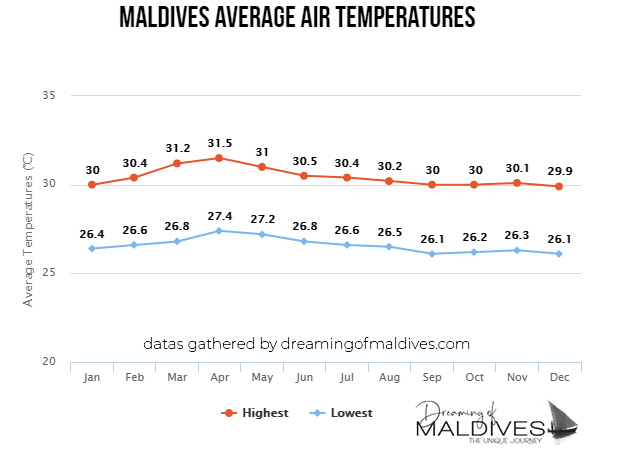
The average minimum temperatures vary little throughout the year and remain stable between 25°C and 28°C. (77˚- 30F˚).
– Highest sea temperatures : 35°C (95F˚)
– Lowest sea temperatures : 24°C (75F˚)
Maldives Monsoon Seasons
The year in the Maldives is divided into two monsoons : the summer monsoon, Iruvai, and the winter monsoon, Halhangu.
While temperatures remain relatively stable throughout the year, each monsoon brings distinct weather conditions—especially in terms of rainfall, sunshine, and wind.
The winter monsoon, “Iruvai”, a dry and sunny season…
Hot and dry, this period of year is the best time to go to Maldives.
Iruvai , A Dry and Sunny Season in the Maldives
Hot and dry, the winter monsoon in the Maldives—called Iruvai in Dhivehi (the Maldivian language)—typically begins around October or November until March / April.
During Iruvai, the weather turns drier and brighter. This season often brings sunny skies, very little rainfall and mild winds. The sea is often exceptionally flat—ideal for beach days and overwater stays.
Iruvai is the best time to Visit Maldives
The Iruvai monsoon is widely considered the best time to visit the Maldives.
It brings long, sunny days, clear blue skies, and sometimes, stunning cloud formations.


Maldives Dry Season in Photos

During the dry season, Maldives skies are often dotted with scattered, elegant white clouds.
The dry season is the best time to enjoy exceptionally calm and flat waters, especially on the lagoon side of islands.

Clear and bright blue sky during the winter season in Maldives.
The summer monsoon, “Halhangu”, a rainy and windy season…
Rainy and Windy, the summer monsoon in Maldives often starts around May to reach its peak around July / August.
The Summer Monsoon, “Halhangu” – A Rainy and Windy Season
The summer monsoon in Maldives, named “Halhangu” in Dhivehi (Maldivian language), often starts in May and reaches its peak around July / August to slowly disappear in October/November in favor of the sunny and dry winter monsoon.
A Versatile weather
Considered as the Maldives winter, Halhangu brings versatile weather that can change in a few minutes.
All of a sudden, skies become dark, strong rains can follow a beautiful sunny morning and wind gusts can reach up to 50 Knts ( app. 90 Km/h).
These dark, rainy and very windy periods can be very short, but they can also continue for a few days and be immediately replaced by idyllic weather conditions.
Winds are generally stable and strong and blow West/ South-West.
Halhangu season is usually not the best time to go to Maldives but can be beautiful too.

you will love /

Why is the Rainy Season
in the Maldives Still Worth It?
The rainy season is probably not the best time to visit Maldives, but…
It holds some incredible surprises for those who know where to look. From breathtaking sunsets and magical encounters with manta rays and whale sharks, to excellent wind conditions for funboarding, kitesurfing and surfing in some parts of the country, this season can turn out to be one of the most rewarding times to experience the Maldives—if you don’t mind a few showers. And, as risky it can be, rain can be followed by sunny periods. Remember there is no exact rule.
Here’s why the Maldives rainy season might just surprise you
3 Good Reasons to visit the Maldives during this period

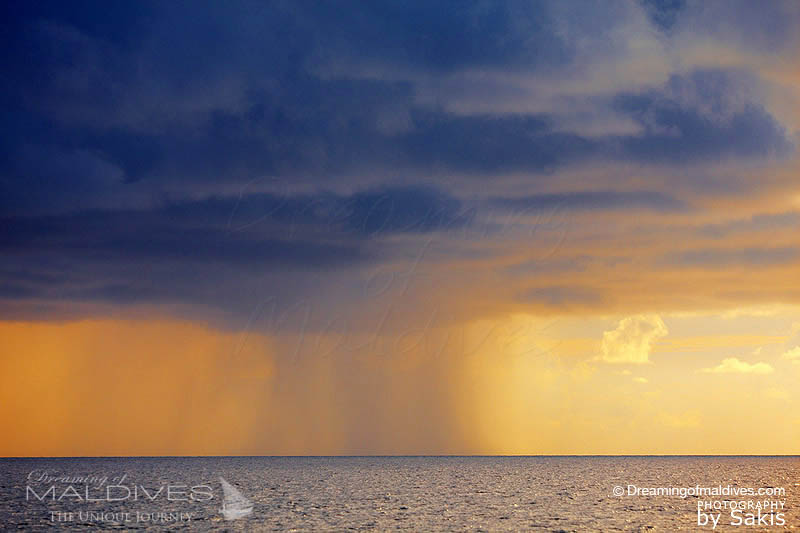
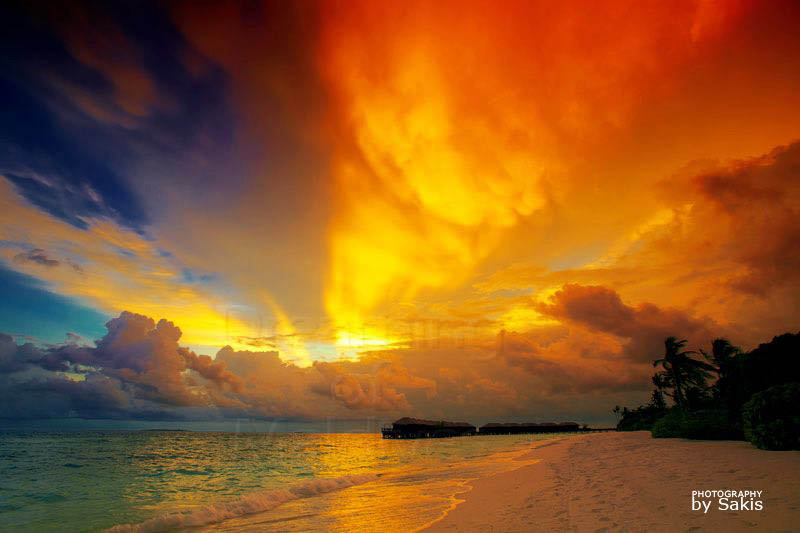
Stay POSITIVE, the rainy season is the best period to witness the most spectacular Maldives sunsets ! This is due to the high humidity in the atmosphere that enhances light diffusion in the sky, creating the most dramatic and colorful sunsets in the Maldives.
Learn more : Video of the most beautiful Maldives sunsets →

Between May and November, plankton-rich currents attract manta rays and whale sharks to Hanifaru Bay in Baa Atoll, making it the best time for snorkeling with these gentle giants.
Learn more : Everything You Need To Know about Hanifaru Bay →

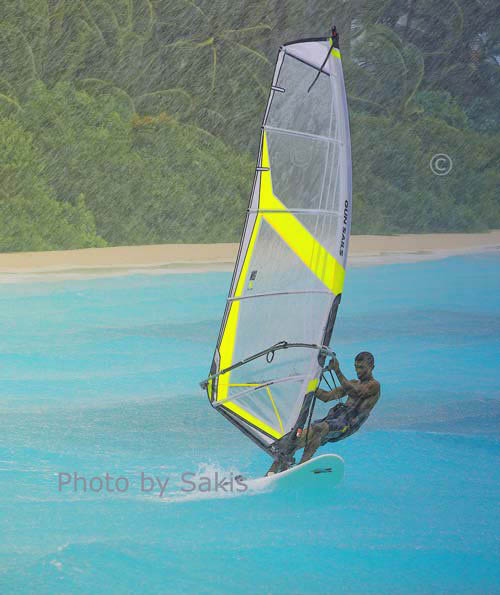
During the rainy season, strong and steady winds are absolutely perfect if you’re into funboard or kitesurf.
For surfing, conditions vary by atoll, but most of the Maldives enjoy consistent waves from March/April to October, sometimes even into November.
Learn more :
– Windsurfing, Funboarding, Kitesurfing in Maldives…all pleasures allowed ! →
– Maldives Complete Surf Guide →
Maldives Rainy Season in Photos

Two waterspouts forming over small maldivian islands.

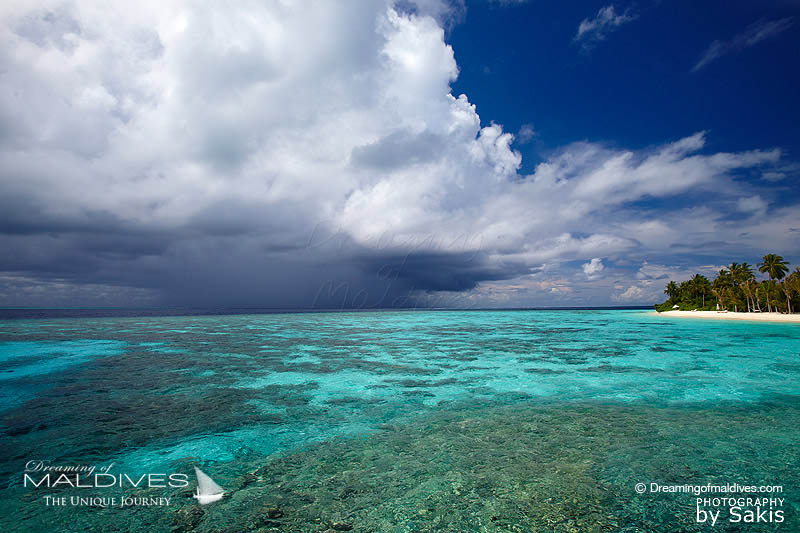
Under dark grey rainy skies, the Maldives lagoon glows even brighter—its blues turning almost phosphorescent.

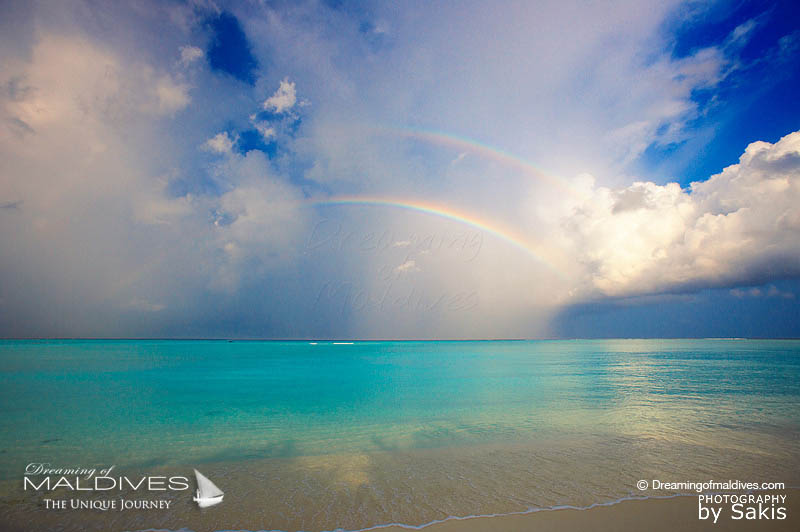
A beautiful rainbow cascading right onto an island. A magical moment of the rainy season in the Maldives.
Maldives Weather Through the Lens : A Photo Gallery
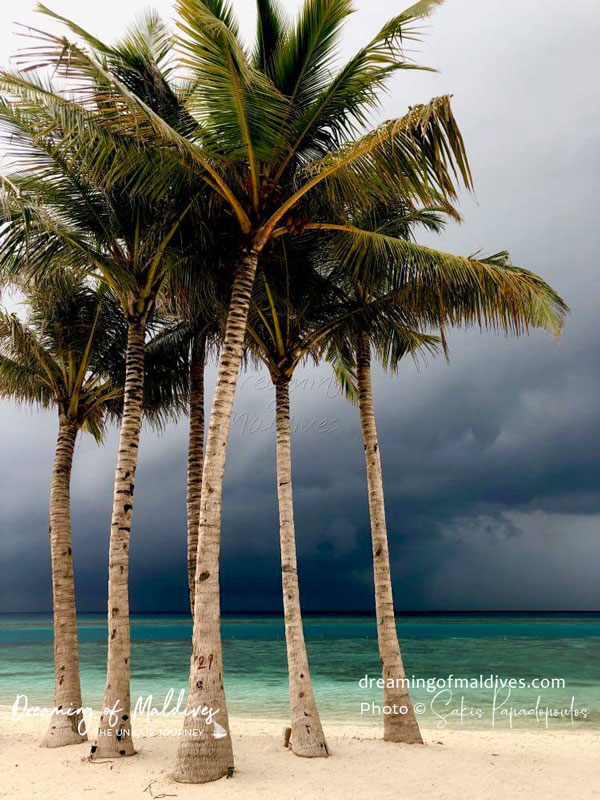
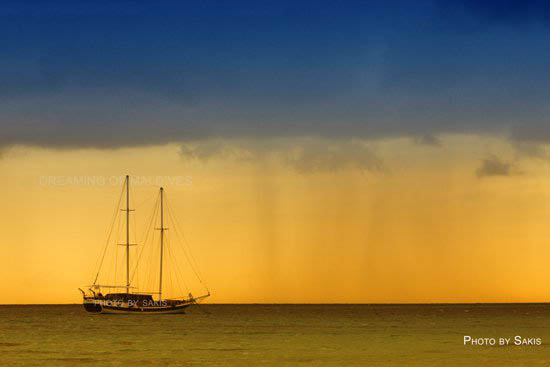
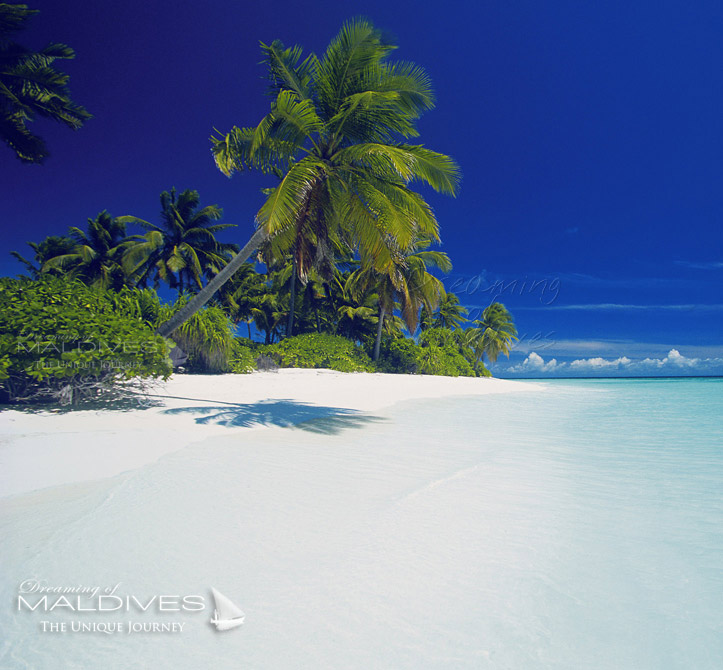
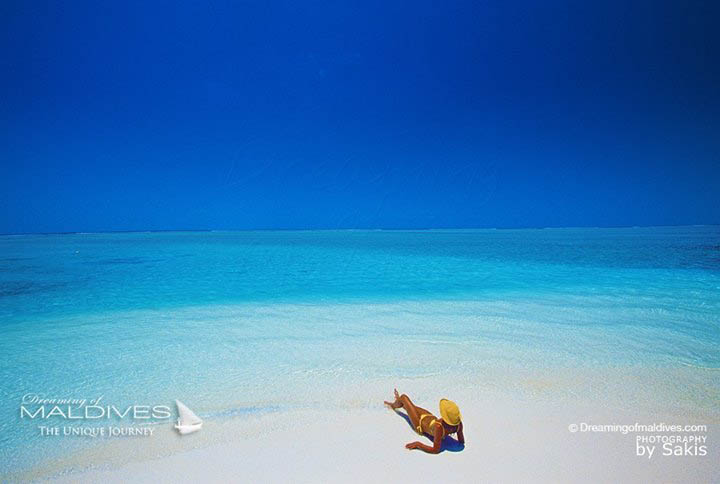
From glowing sunsets to glassy lagoons, stormy skies to rainbow-lit islands—here is the Maldives, season by season, we captured in timeless moments.


Can You Really Predict
the Weather in the Maldives ?
Don’t trust Maldives general weather patterns, because they are not what they used to be.
Predicting the weather in Maldives can feel like trying to forecast summer in Europe or New York : Yes, it will be hot, but it might rain and storm too ! Patterns have changed and the Maldives climate is changing too.
What you see online or in travel brochures doesn’t always match reality. A bright forecast can turn into heavy rain… or the opposite.
Don’t rely too much on general predictions.
November is usually safer, but even then, the weather can be moody. Still, you can leave with a light heart—you’ll almost always enjoy beautiful days during your stay.
Traditional Weather Wisdom – The Nakaiy Calendar
Did you know that Maldivians have their own way of reading the weather?
For centuries, they’ve followed the Nakaiy calendar—an ancestral system based on monsoon cycles and nature’s rhythms.
Learn more about the Nakaiy calendar →
See also


Maldives Weather & Climate
Frequently Asked Questions (FAQ)
Got questions about the weather in the Maldives?
Whether you’re planning a trip during the dry season or wondering what to expect from the rainy months, this FAQ covers everything you need to know — from temperatures and monsoons to the best times to visit and local weather patterns across the islands.
The Maldives has a tropical climate with warm temperatures and high humidity year-round. Expect average highs between 30°C and 32°C (86°F – 90°F), and sea temperatures around 28°C (82°F).
The best time to visit is during the dry season (Iruvai), which usually runs from November to April. Expect plenty of sunshine, calm seas, and little rain.
Yes, especially during the wet season (Halhangu), which typically runs from May to October. However, showers are often short and followed by sunshine.
No. The Maldives stretches over 800 km from north to south, so weather conditions can vary across the atolls. For example, Gan in the south may experience different patterns than Malé in the north.
Air temperatures usually range from 25°C to 32°C (77°F – 90°F). Humidity is high, especially during the rainy season.
Sea temperatures stay consistently warm, between 25°C and 30°C (77°F – 86°F), making it ideal for swimming, snorkeling, and diving all year.
Absolutely. While the weather is more unpredictable, it’s also when you’ll find the best surfing, kiteboarding, and the manta ray season in Baa Atoll. Plus, some of the most dramatic sunsets happen after a tropical shower.
The Maldives is rarely affected by cyclones thanks to its location near the Equator. The country generally remains safe from major tropical storms.
Read more : Maldives Hurricanes and Tsunamis.
Continue exploring


All photos © Dreaming of Maldives – All rights reserved.
Follow us on Facebook, Youtube and Instagram
for more Maldives Dreams & Stories